
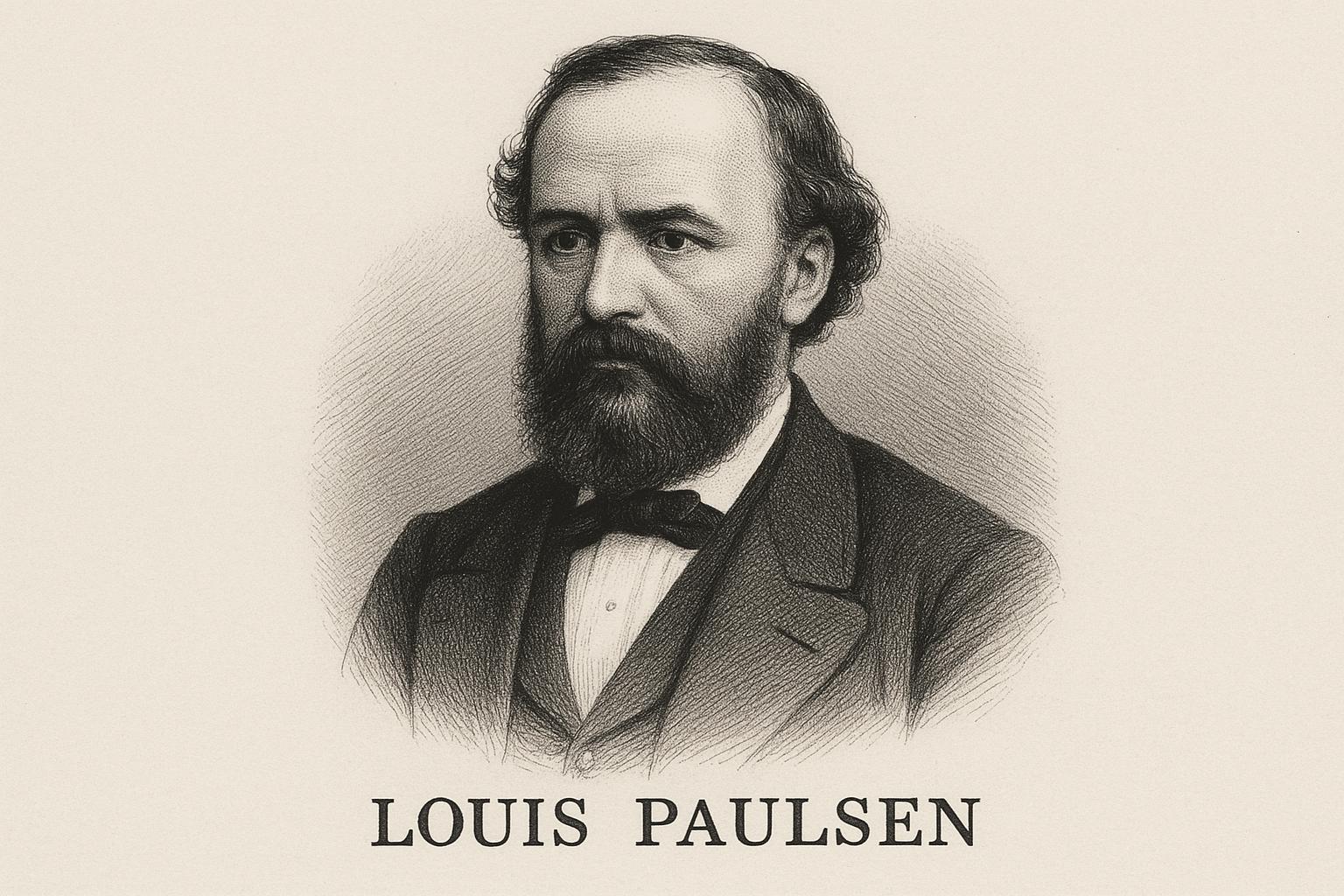
Early Life and Background
Louis Paulsen was born on January 15, 1833, in a small town called Niemegk in Germany. The 19th century was a transformative period in chess history, and Paulsen emerged as a pivotal figure within this context. Despite hailing from a relatively obscure town, Paulsen rose to prominence within the chess community, leaving an indelible mark on the game’s development both as a player and a theorist.
Paulsen emerged during a time when chess was evolving into a more structured sport with well-defined rules and international competitions. This was an era that witnessed the transition of chess from casual parlor games to organized tournaments which drew competitors from across the globe. In this emerging landscape, Louis Paulsen played an instrumental role, not just as a competitor, but as a thought leader whose contributions would resonate well beyond his lifetime.
Competitive Career
Louis Paulsen made his debut in the international chess scene in 1857, a year that marked a significant juncture in his career. The occasion was the first American Chess Congress, conducted in New York City. It was a prestigious event that drew some of the best minds in chess at the time, and Paulsen’s performance was nothing short of extraordinary. He finished in second place, trailing only behind Paul Morphy, who is often considered one of the all-time greats in the history of chess.
This accomplishment was more than a mere statistical achievement; it showcased Paulsen’s strategic acumen and underscored his capability to compete at the highest level. This tournament served as a launchpad for Paulsen’s career, affording him the recognition of being a world-class player, which in turn opened up numerous opportunities for him to further his interests and innovations in chess.
Defensive Style and Contributions
One of the aspects that set Louis Paulsen apart from his contemporaries was his distinctive style of play. Unlike the aggressive, tactical approaches that characterized the strategies of many of his peers, Paulsen was renowned for his defensive style. He adopted a methodical approach that emphasized positional understanding and control, rather than engaging in aggressive tactical skirmishes.
This strategic restraint allowed him to dictate the tempo of his games, frustrating opponents who preferred more dynamic and aggressive encounters. As such, Paulsen became a master of defensive play, a strategy that was not only effective but also revolutionary for his time. His contributions weren’t confined to mere gameplay; they extended to theoretical aspects as well, especially in the realm of opening strategies.
Theoretical Innovations
Paulsen’s impact on chess extended through his theoretical contributions, especially his work on the Sicilian Defense. One of his key contributions was the development of what became known as the Paulsen Variation of the Sicilian Defense. This variation, also referred to as the Paulsen-Kan Variation, offered a fresh perspective and strategic depth. With …e6 as a key move, this opening line aimed at providing black with a solid, yet flexible position that could withstand white’s initial onslaught.
The beauty of the Paulsen Variation lay in its adaptability. It presented a balanced structure, combining both defensive robustness and the potential for counterattacks. It became an attractive option to counter white’s aggressive play and remains a popular choice among players seeking a sound yet dynamic strategy while playing as black. Paulsen’s innovative efforts in this regard left an indelible influence on opening theory, a testament to his deep understanding of the game.
Legacy and Impact
Louis Paulsen’s legacy in the chess world is characterized by his substantial influence on the game’s strategic landscape. His distinct playing style and innovative contributions reverberated throughout the chess community well beyond his lifetime. Paulsen wasn’t solely a remarkable player; he was also a catalyst for the popularization of chess in Germany, advocating for the game’s expansion and institutional growth.
His influence extended far beyond the chessboard, impacting players and theorists who succeeded him. The strategies and principles espoused by Paulsen continue to be topics of study and admiration among modern chess enthusiasts and professionals alike. His work contributed significantly to the evolution of chess, bridging the gap between historical practices and contemporary strategic approaches.
Conclusion
Throughout his life, Louis Paulsen demonstrated a remarkable ability to innovate and adapt within the ever-evolving realm of chess. His influence is manifested in the historical context of the game and continues to be relevant in current strategic methodologies. From establishing defensive strategies to pioneering new theoretical insights, Paulsen stands as a seminal figure in chess history.
In summary, Louis Paulsen’s contributions enriched the game substantially, making chess not only a test of tactical prowess but also a testament to intellectual perseverance and strategic ingenuity. His work laid critical foundations that continue to support the edifice of modern chess, underscoring his status as a visionary within the chess community.