
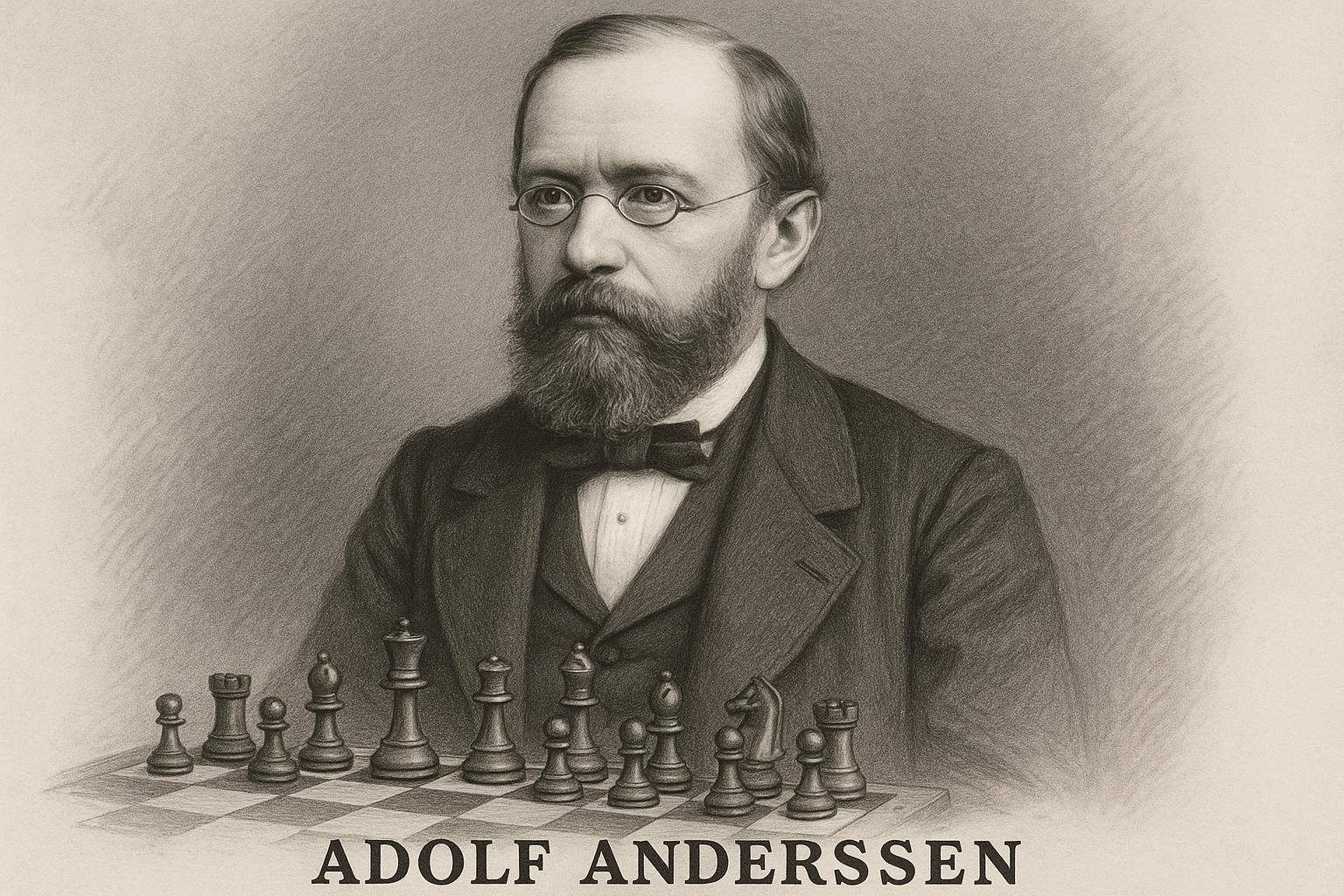
Adolf Anderssen: A Pioneering Chess Master
Adolf Anderssen, a significant figure in the history of chess, was born on July 6, 1818, in Breslau, Prussia, now Wrocław, Poland. He is remembered as one of the strongest players of his time, particularly noted for his contributions to the Romantic era of chess, which emphasized bold and tactical play with a focus on daring sacrifices and complex combinations. Anderssen’s style and notable wins have left a lasting impact on the game.
Chess Career and Achievements
Anderssen’s official arrival on the international chess scene was marked by his participation in the London Chess Tournament of 1851, which was the first international chess competition. He surprised many by emerging victorious, defeating several prominent players of the era. This monumental achievement earned him the unofficial title of the world’s best chess player, a reputation that would precede him throughout his career.
Among his most famous games, often cited as masterpieces of tactical brilliance, are the “Immortal Game” against Lionel Kieseritzky in 1851 and the “Evergreen Game” against Jean Dufresne in 1852. These games are celebrated for their dramatic nature, featuring strategic sacrifices and creative maneuvers that showcased Anderssen’s deep understanding of chess dynamics.
Playing Style
Anderssen was celebrated for his aggressive and imaginative style of play. This approach was characteristic of the Romantic period in chess history, where players prioritized attacking the opponent’s king and making spectacular moves at the expense of cautious play. Although this style occasionally led to speculative situations on the board, Anderssen’s skill often brought these bold efforts to fruition.
While his emphasis on tactical fireworks was admired by his contemporaries, it also drew criticism from later generations of chess players who favored a more positional and strategic approach to the game. Nevertheless, his ability to conduct complex attacks and his fearless manner of play made his matches highly entertaining and educational for chess enthusiasts.
Legacy and Influence
Adolf Anderssen’s contributions left an indelible mark on the world of chess. He not only inspired future generations of chess players with his creative tactics but also exemplified sportsmanship that elevated the competitive spirit of the game. His influence is evident in the way chess became increasingly popularized as a test of intellectual prowess and artistic ingenuity.
Although Anderssen’s period of dominance eventually waned, his games continued to be studied and analyzed, significantly enriching chess literature. His legacy endures as a testament to the adventurous and creative spirit of chess’s Romantic era. For those interested in studying historical chess games, Anderssen’s contributions provide a resourceful guide to understanding the evolution of chess strategies over time.
Educational Impact
The educational impact of Anderssen’s games is profound. Aspiring chess players often study his games to gain insights into high-level tactical thinking. These games are not merely historical artifacts; they are living documents, rich with lessons on how to approach the board with creativity and courage.
One aspect of Anderssen’s games that continues to attract analysts is the inventiveness he demonstrated in complex positions. His flair for turning a disadvantageous situation into a winning advantage showcases the practical application of creativity in chess. This skill is one that many modern players strive to emulate, even as the game’s strategic frameworks have evolved.
Scientific Approach to Chess
While Anderssen played during a time that celebrated the artistic nature of chess, his methods helped lay the groundwork for a more scientific approach to the game. With the romanticism of his era, Anderssen’s games underlined the importance of understanding thorough tactical themes. He provided early examples of how a match could be systematically dismantled to elucidate deep strategic truths, thereby paving the way for more analytic approaches that followed in chess’s evolution.
The scientific approach to chess, which emerged more prominently with figures like Wilhelm Steinitz, can be traced back to foundations laid by players like Anderssen, who maneuvered with both flair and foresight. His games are considered models for balancing risk and reward on the chessboard and remain relevant in the study of chess pedagogy.
Chess Literature and Legacy
Adolf Anderssen’s games have contributed immensely to the corpus of chess literature. Numerous books analyze his matches, discussing the tactics and strategic insights found within. Chess educators often draw upon Anderssen’s games to illustrate fundamental concepts in chess tactics, such as sacrifices for positional advantage and maintaining an aggressive posture during play. This legacy extends into digital resources, where players can engage with his games interactively.
Several openings and strategies are indirectly inspired by Anderssen’s approach, as subsequent generations refined the bold strategies he employed. His strategic acuity is reflected in many instructional guides that aim to introduce advanced tactical concepts to learners. Such continued relevance highlights Anderssen’s enduring impact on the rich tapestry of chess history.
Conclusion
Adolf Anderssen’s contributions to chess continue to be a cornerstone for understanding the game’s historical and tactical development. His games serve as testimonies to the beauty of tactical ingenuity, lending invaluable insights into the progression of chess over time. Countless aspiring chess players and enthusiasts dive into his legendary games, finding both inspiration and instruction, underscoring Anderssen’s far-reaching impact that extends well beyond his own era. His influence remains a guiding force in the dynamic and ever-evolving world of chess.